
Search Greenbrier Property Records
A Greenbrier search is a chain of cross-references. Start with the Assessor. Its property search turns up the owner, the legal description, appraised land and building values, and a deed book and page reference for the parcel. Carry that reference to the County Clerk's Online Deed Inquiry or the courthouse terminals and read the recorded instrument itself. Tax questions belong to the Sheriff or Treasurer. The WV Property Viewer then lets you compare the tax parcel with its mapped outline. Each office answers a different question. The evidence holds up best when the parcel number and deed reference agree across all of them.
Use this order to check one Greenbrier property:
- Search the WV Assessment property search by address, owner, or parcel ID.
- Save the parcel ID, legal description, owner field, and deed book/page shown on the result.
- Check the Clerk index for the cited deed and search both grantor and grantee names for earlier transfers.
- Use the WV Property Viewer to compare the parcel shape, address, roads, and map layers.
- Ask the right custodian for a counter lookup, inspection, or copy when the online record is missing or unclear.
The Assessor card answers a quick ownership question. It can stand alone for that. A purchase, inheritance or boundary concern needs the underlying deed, plus professional title or survey work where the stakes justify it.
Greenbrier Property Records Offices
Several Greenbrier offices share the courthouse in Lewisburg. Their records are not interchangeable. The County Clerk records deeds, mortgages, liens, plats and County Commission instruments. The Assessor maintains the annual roll and parcel information. The Sheriff's Tax Office prints tax tickets and tracks payments. Planning & Permits and the Health Department add construction, zoning, floodplain, septic and well records, and the Clerk's counter remains the fallback when an online index will not disclose its coverage.
Greenbrier County Clerk
912 Court Street N.
Lewisburg, WV 24901
304-647-6602
Greenbrier County Assessor
912 Court Street North
Lewisburg, WV 24901
304-647-6615
Match Greenbrier Parcels to Deeds
An Assessor result is a bridge to the Clerk. Its deed book and page point toward a recorded instrument, while the parcel ID and legal description separate a tract from land held by a similarly named owner. The Clerk advertises an Online Deed Inquiry. The official material does not state the earliest searchable year, any image cutoff, or the exact index fields. A blank online result proves nothing about recording. Use the public courthouse computers, or ask the Clerk to help locate the relevant deed book and index.
Work backward from the last grantee. Read the current deed's grantor and its prior reference. Find that grantor as an earlier grantee, then repeat. Search both name directions and keep spelling variants in play. The Assessor's annual owner field is a practical start. A just-recorded conveyance may show up first in the Clerk's deed index, and Greenbrier deed records cover deed types, index work and copy access in more detail.
Types of Greenbrier Property Records
No single master certificate exists for a Greenbrier property. A file is built from linked records. The deed records conveyances and legal descriptions. The assessor card tracks the tax parcel and its appraised values. Tax tickets show charges and payment status, GIS supplies the mapped reference, and planning, court, fiduciary and environmental-health files add context for construction, a dispute, an estate transfer or private utilities.
| Record Type | What It Documents | Kept By | Access |
|---|---|---|---|
| Deeds and plats | Transfers, legal descriptions, lot references | County Clerk | Online inquiry or courthouse terminals; coverage unstated |
| Mortgages and liens | Recorded debt, releases, judgments, easements | County Clerk and courts | Index, counter, or clerk-assisted file search |
| Assessment roll | Owner, parcel, land/building/total appraisal | County Assessor | WV Assessment search and tax map |
| Tax ticket | Current charge, payment and delinquent status | Sheriff / Tax Office | WV property tax lookup and office |
| Parcel and permit | Map context, work, zoning and flood review | Assessor, GIS, Planning & Permits | Viewer, Cloudpermit or paper request |
Use the deed for the recorded transfer. The assessment gives the current tax-roll snapshot. The tax ticket shows amounts due, but the mapped parcel is only a locator, never a survey. Each source can lag or omit what another office holds, so save the identifiers that connect them: district, map and parcel numbers, deed book and page, and the legal description.
Search Greenbrier Assessment Fields
The state assessment form is the broadest entry point. It helps when an address is incomplete or the parcel is known only by an owner's name. It offers Basic, Appraisal/Sales, Advanced and Prior Ownership modes. Search choices include county and district, full parcel ID, owner, map, street name, parcel and sub-parcel. Advanced filters narrow results further. Filter by appraisal range, calculated or deeded acreage, sale date and price, flood hazard, mailing address, deed book and page, legal-description text, building year, structure count or building area.
The form does not publish exact-match behavior for owner or street searches. The roll's historical depth is unstated. Start broad, then narrow by district or parcel. Results can display the legal description and GIS parcel ID, which helps carry the same property into other systems.
Open the WV Assessment search form to see the actual Greenbrier fields. The statewide form handles the county lookup. Filters and modes appear exactly as described.
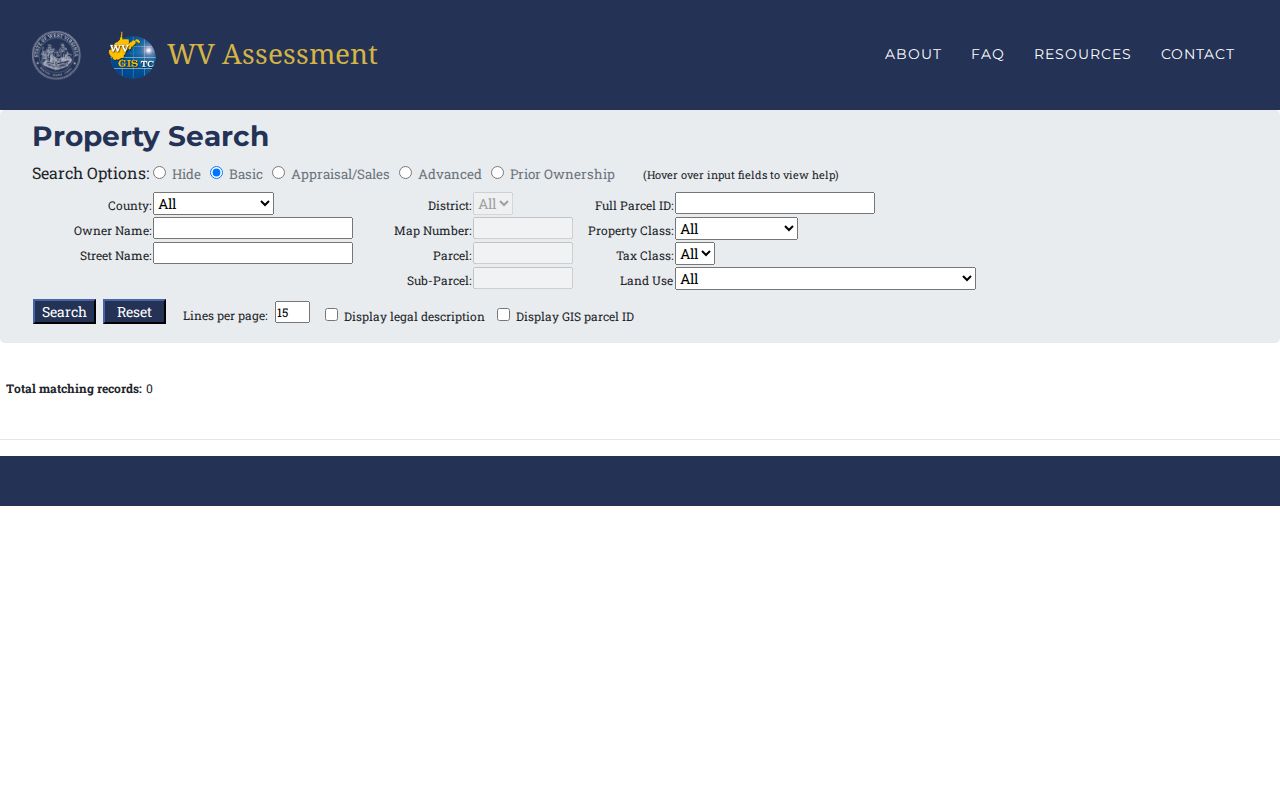
Note the owner, legal description and deed reference. Carry them to the Clerk index. The form is only a finder; the recorded deed remains the instrument that documents the transfer.
Greenbrier Tax Tickets and Dates
The Assessor values property annually as of July 1 at true and actual value. The office says land and personal-property books are completed by January 30 and values certified by March 3. The County reports that tax tickets are mailed by July 15. Those dates describe separate steps: an assessment is the valuation record, while the Sheriff’s ticket applies levy rates and states the bill. A taxpayer who spots a value concern should review the appeal period and current forms with the Assessor rather than treating a tax payment screen as an appeal filing.
Greenbrier offers a 2.5% discount on the first half paid by September 1 and on the second half paid by March 1. April 30 is the last day to pay without penalty. Online card payments add a 2.95% processing charge with a $2 minimum. Delinquent real-estate taxes have stricter payment methods: cashier’s check, money order, certified check or U.S. currency. For a parcel that may be delinquent, verify status with the Tax Office because a GIS delinquent label does not itself transfer title.
Greenbrier GIS Parcel Viewer
The WV Property Viewer accepts several search routes. You can query by E-911 address. Parcel attributes, geometry or coordinates work too. Parcel attributes take a full parcel ID. Or enter just parts of the district, map, parcel and suffix. The map layers parcel polygons with roads, aerial imagery, hydrography, soils and flood data. Select a parcel. The owner field, physical address, legal description, building information, cost and appraised values, delinquent status and a county assessment report come into view. Identify, measure, copy-link and KMZ download tools round out the viewer.
The Assessor Interactive Tax Map covers similar ground. Parcels, roads, hydrography, soils and aerial images all display. A selected parcel can show its neighborhood, deed book and page, and separate land, building and total appraised values. These layers are great for locating a tract or reading context. Still, area measured on a screen is not a boundary survey. When lot lines matter, rely on the recorded plat or the deed's legal description. Bring in a licensed surveyor to settle a boundary.
Greenbrier Permits and 911 Addresses
Planning & Permits ties applications to the tax district, map, parcel and lot. It also requires a physical 911 address. Its Cloudpermit workflow lets an applicant submit plans and a site plan. Applicants can check application or inspection status there. They can also schedule or cancel inspections, message staff, pay by card or e-check, and send changes. Paper applications remain an option. The paper form asks for owner and applicant details and a mailing address. It also wants utility authorization, contractor license and construction type. Ownership changed within two years? The form wants the previous property owner listed too.
A new physical address has to come from County Emergency Management. It is required before a certificate of occupancy. Septic or well approvals may sit with Environmental Health. That office handles septic, well, subdivision and related permits. County zoning and floodplain review can apply outside a municipality. Incorporated areas may run their own planning process or hand it to the county. Public search access to every permit file is not stated anywhere. Call Planning & Permits when a past permit does not surface through the online workflow.
Greenbrier Online and Counter Records
The County Clerk offers an Online Deed Inquiry plus four public computer stations at the courthouse. The online index's starting year is not stated on the published page. An imaging cutover is not stated either. Exact fees for online images are also absent. Older books and index volumes may be missing from the online index. Those records may call for counter or archive research. Regular weekday hours run 8:00 a.m. to 4:30 p.m. The office advises contacting the custodian for access details.
Copying has its own price list. The County Fees & Records page lists $1.50 for the first two pages. It lists $1 for each additional page. A search result, an ordinary copy and a certified copy are different products. Ask what you are getting before paying. The current Fees & Records page links the online database and posts the copy schedule. Knowing the difference helps when you need a quick title clue versus a document for a formal transaction.
What Greenbrier Records Can Prove
Greenbrier County's public files can prove real things: a recorded grantee, an assessment owner, an appraised amount, a tax balance, a parcel outline or a permit history. They do not all update at once. A recently recorded deed can be newer than the annual assessment roll, and the GIS viewer may show just one owner on a parcel that has several. A tax delinquency marker is not a tax deed. A map line is not a surveyed boundary. And an appraised value is neither an offer price nor a sale appraisal.
Lawful use. Greenbrier County records support property research, purchase diligence and civic review. Do not use owner details to stalk, intimidate or harm anyone; the map and roll are not title or survey opinions.
Greenbrier FOIA and Protected Addresses
West Virginia's Freedom of Information Act, found at W. Va. Code §§29B-1-1 through 29B-1-7, covers records held by public bodies except where an exemption applies. A good request names the parcel or address, the record type and the approximate year. Specificity matters. The custodian must respond as soon as practicable, and no later than five days, excluding weekends and legal holidays. Fees are limited to actual reproduction cost. Search and retrieval labor cannot be charged. The County Sheriff posts an FOIA page with an incident-focused request form, but parcel records live elsewhere. Send a property records request to the Clerk, Assessor or Planning custodian directly so it does not land in the wrong office.
Some addresses carry special protection. West Virginia's Address Confidentiality Program enrolls eligible participants for four-year periods and gives them a substitute address with mail forwarding. It does not erase the underlying property records. The Secretary of State explains eligibility and the trained Application Assistant process on its ACP information page. Respect protected addresses. Use public records only for lawful property, history and civic research.
Greenbrier’s Virginia-Era Deed Books
Greenbrier County dates to March 1778, carved from Virginia's Montgomery and Botetourt counties. That origin matters for deed research. The land record trail begins before West Virginia statehood. It weaves through Virginia-era grants, early county deeds and later books under shifting jurisdictions. A catalog lead points to Greenbrier Deed Books 1 through 5 covering 1780–1814. Will Book 1 covers 1777–1833. Deed references also appear from 1750–52, 1754, 1769 and 1783–84. Treat these as leads. Not every volume is online.
The Greenbrier County history page tells the county's formation story and lists its present municipalities. That origin explains why an early chain of title may require a predecessor-jurisdiction search. Pair it with a modern county lookup.
Confirm any holding, call number and copy access with the Clerk or archive before leaning on a catalog reference. Catalogs drift from shelf reality. Old instruments often identify land by creeks, roads or adjoining owners instead of a modern street address. Search variant spellings, and read the legal description closely.
Greenbrier House History Sources
A house history starts with the current parcel and its deed references. It then turns to local collections for the people and places behind the paper. The Greenbrier Historical Society archive holds courthouse documents, marriage bonds, family histories, journals, vertical files, The Greenbrier Independent, newspapers, obituaries, school records, yearbooks, directories and periodicals. Research visits require an appointment at least 24 hours ahead. The archive is open to the public. Staff decide whether scans or copies are possible, and a small fee may apply.
The Historical Society archive page describes its holdings in detail. The County Public Library offers a catalog and databases. Its public page does not list directory years, though. Ask about a specific title or date range rather than assuming a run exists. Start with the deed and the legal description. Newspapers, directories, yearbooks and obituaries supply context, not proof of ownership. The Greenbrier County Public Library page has current catalog and access details. Together the archive and the library add human texture. They enrich a land chain that begins in the county's record books.

Check the Greenbrier County Public Library page before planning a catalog visit. It carries the current catalog and access details.

The library is a supporting stop for local references. Deeds and plats still come from their county custodians.